
Dallas County Busted Mugshot Records
That picture taken when someone enters the Dallas County Jail has one narrow purpose. It identifies the person in custody. Nothing more. The jail, run by the Dallas County Sheriff's Department, creates the booking photo along with an intake sheet. Selma Police might hold a separate incident or arrest report for the same event. A state or federal agency can hold yet another piece. So the office you ask matters. One may hold the arrest narrative, another the full booking packet.
The jail employs 28 staff. It houses roughly 180 people on a typical day, according to county figures. Sheriff materials also describe patrols across 976 square miles, warrant service, transports, and jail operations around the clock. During booking, staff log identity, custody authority, charges, property, and bond details when available. Release or transfer gets logged too. The photograph only shows that this processing happened after a busted person entered the jail.
Dallas County Booking Record Fields
Keep any request narrow. Name the exact fields you want. Dallas County has published no roster spec for its booking records, so treat this inventory as items that may appear in a responsive packet. Nothing here promises every field gets released. Ask the custodian to flag what is responsive and to hand over the parts that are not exempt, with the rest redacted.
| Field | What it may show |
|---|---|
| Name and aliases | The identity used during intake |
| Booking or jail number | The local intake identifier |
| Arrest and booking dates | When custody and intake events occurred |
| Arresting agency | The office that made or delivered the arrest |
| Charges as booked | Accusations presented at intake, which may later change |
| Warrant or case number | A link to the underlying process or court file |
| Bond and release fields | Recorded bond type, amount, release date, or transfer |
| Photographs and fingerprints | Identification material created during covered intake |
These three documents do different jobs, and blending them causes confusion. An arrest report gives the officer's account. A booking record logs jail intake. A court case file comes later and tracks charging decisions, pleas, hearings, dismissals, judgments, and sentences. Outcomes shift along the way. A prosecutor can drop or amend the booked charge, and a grand jury may return something different or no bill at all. So keep the arrest record, the booking sheet, and the court docket separate when you read them.
Request Dallas County Busted Records
The county pages show no public booking-photo request form, no fixed photo fee, and no guaranteed response time. A plain, focused written request is the supported route. Alabama's public-writing statutes supply the general starting point for access. Exemptions and reasonable custodian rules still apply. Ask for an electronic copy and an advance estimate instead of importing another agency's price.
- Identify the person by full name, approximate arrest date, date of birth if known, and arresting agency.
- Address the records custodian at the Dallas County Sheriff’s Department. Request the booking sheet and dated front and profile photographs separately.
- List the booking number, booked charge, arresting agency, bond, release, and transfer fields needed. Ask for segregable, nonexempt portions.
- Request electronic delivery, an advance cost estimate, and the legal basis for any withholding.
- If no record is found, ask whether it was transferred, destroyed under an approved schedule, or withheld under cited authority.
102 Church Street
Selma, AL 36702
334-874-2530
dallascoso@dallascounty-al.org
Monday-Friday, 8:00 a.m.-4:30 p.m.
The Sheriff and the jail publish different contacts. The temporary jail page gives 4805 U.S. Highway 80, zip 36786, plus 334-690-1200 and weekday administrative hours from 8:00 a.m. to 5:00 p.m. A sheriff flyer separately lists 334-690-1203 for the temporary jail. Confirm before you visit.
A good request tells apart "no responsive record" from "not available online." If the custodian cannot find the Dallas County booking packet, ask which record series was searched and over what date range. Several answers get confused with each other. A transfer to another agency, an approved destruction, a legal withholding, and an empty search are all different things. When a record no longer exists, request the retention schedule title. That detail can reveal whether the photograph, intake sheet, jail register, and fingerprint file each followed different retention rules.
Fees and timing remain open. Dallas County has posted neither a booking-photo price nor a response promise, so ask for an estimate before copies get made and offer to narrow a broad date range. Alabama Archives research-service prices do not bind the Sheriff, and the paid court portal serves a different purpose. Keeping those costs separate stops an archive or court charge from being mislabeled as a county mugshot fee.
Note: A phone custody answer is not the same as a releasable copy of the Dallas County booking record or photograph.
Dallas County Temporary Jail Contacts
The temporary facility creates a routing puzzle unique to Dallas County. The jail page names 4805 U.S. Highway 80, zip 36786, as the current temporary spot. Its main number is 334-690-1200. The sheriff flyer prints 334-690-1203 as a separate temporary-jail line, so keep those two labeled rather than treating them as one. The Sheriff's administrative and records office stays at 102 Church Street in Selma.
Call ahead, since a temporary address can shift. Say why you're coming, whether it's current custody, a records request, bond information, or another jail function, and confirm the right place for that task. The facility page posts weekday administrative hours. The sheriff flyer adds a 24-hour dispatch line for public-safety business. Emergencies go to 911, never a records line.
Dallas County Busted Record Fees
Dallas County posts no booking-photo fee and no fixed response promise. The smart request asks for electronic delivery, an advance estimate, and room to narrow the scope before chargeable work starts. Details help. A precise name, date range, booking number, and record description cut ambiguity fast. If the custodian quotes production costs, confirm what each charge covers before you authorize copies.
Never import the Alabama Archives research fee, an ADOC processing charge, a court portal cost, or another sheriff's schedule. Each belongs to a different custodian and a different service. No posted photo fee does not mean the copy is free. It also does not license any page to invent a price. Confirm fees and timing with the Sheriff directly.
Alabama Busted Mugshot Law
Alabama gives the public a right to inspect and copy government writings under Ala. Code § 36-12-40. Section 36-12-41 covers access plus certified copies. Neither statute promises a free electronic copy, an online Dallas County mugshot gallery, or a deadline for the sheriff to respond. Records tied to investigations, law enforcement, juveniles, victims, medical care, or security can be withheld or redacted under other rules.
A separate block, §§ 41-9-620 through 41-9-625, handles arrest-identification data such as fingerprints and booking photographs. Being photographed at booking does not mean the image goes online. Section 41-9-625 also covers disposition reporting. It covers removal of certain state-system information when a person is released without charge or cleared through proceedings. That remedy works through the agency, though, and it differs from a court expungement. It also cannot wipe out every independent copy someone may hold.
Note: Removal under § 41-9-625 is an agency process and does not reach copies held outside the state system.
Booked is not guilty. Check the Dallas County court disposition before drawing any conclusion from an arrest record, charge, or booking photograph.
Alabama has no statute aimed squarely at private mugshot publishers or their pay-to-remove timetables. That gap does not leave the field wide open. Ordinary public-records, privacy, expungement, and deceptive-practices law still applies. The ALEA expungement hub lays out how eligible people get certified records and file a petition in the right circuit court. Waiting periods, exclusions, notice requirements, and filing costs all depend on the current statute and the person's own case facts.
A wrong or stale private page should be fixed at the source first. Recently Booked offers a free review policy even though its Dallas County route no longer works, and Mugshots.com says expunged records come down without payment. Send the least proof needed, and never pay a vendor that threatens to keep a photo up. Once the source changes, Google's outdated-content tool or Bing's reporting route can clear stale search copies.
Dallas County Youth Records Withheld
Dallas County runs its own juvenile detention facility. That page describes operations, though, rather than serving as a photo source. Alabama restricts juvenile court and law-enforcement records through §§ 12-15-133 and 12-15-134. Youthful-offender status is a distinct protection inside adult court. Section 15-19-7 bars public inspection of photographs, fingerprints, and related records unless an exception or a court order allows it. ADOC likewise excludes Youthful Offender Act inmates from its public search.
A missing youth record signals nothing about the case itself. Do not chase leaked images of minors. The proper route is a court or agency request, and only when the law actually authorizes it.
Find Dallas County Busted Mugshots
Dallas County, Alabama has no verified online sheriff roster. It has no recent-bookings feed either. That pushes the official path toward direct confirmation and a formal record request. A quiet web search proves nothing. Same-day paperwork may still be moving among the arresting officer, the magistrate, the jail, and the clerk before it surfaces anywhere public.
- Identify whether Selma Police, the Sheriff, ALEA, or another agency made the arrest.
- Call the Dallas County Jail for current local custody, and ask whether the person is held, released, or transferred.
- Request the booking sheet and photo from the Sheriff. Request the arrest report from the arresting agency.
- Use Alabama Trial Court Records or the Dallas County Circuit Clerk to follow the case and final disposition.
- Use ADOC only after commitment to state prison. Use BOP or ICE only for the matching federal or immigration custody stage.
Search with complete names and a booking-date range. If the intake is fresh, ask for the booking number too. Private posts can linger long after custody ends. An official jail answer may shift following bond, release, or a transfer to another facility.
Where Dallas County Busted Photos Appear
Each publishing channel reflects a different custody stage. Official sources come first. They name their creator and can be matched against the court outcome. Secondary publishers rank last, since their pages can be incomplete or stale.
| Channel | Photo? | Status and access |
|---|---|---|
| Dallas County Jail | No public web photo | Official current local custody; call or request records |
| Sheriff records | May be responsive | Official booking packet request |
| ADOC search | Often an institutional photo | Official sentenced state custody, not recent county intake |
| Circuit Clerk / Just One Look | Not the photo source | Official case filings and disposition |
| Selma Times-Journal / regional news | Sometimes | Selected event reporting, not a roster |
| Mugshots.com county archive | Yes | Unofficial historical selection; verify every fact |
The Mugshots.com Dallas County archive holds a small historical set. It is not a current-custody source. Busted Newspaper shows no live Alabama county page, and Recently Booked's county route is gone. No stable Arrests.org or Mugshots.zone page for the county was verified. Texas results do not fill those gaps. They are simply the wrong state.
The interface shown below comes from the unofficial historical county page. It appears only after the official routes. Think of it as a sample of the secondary landscape, nothing more.
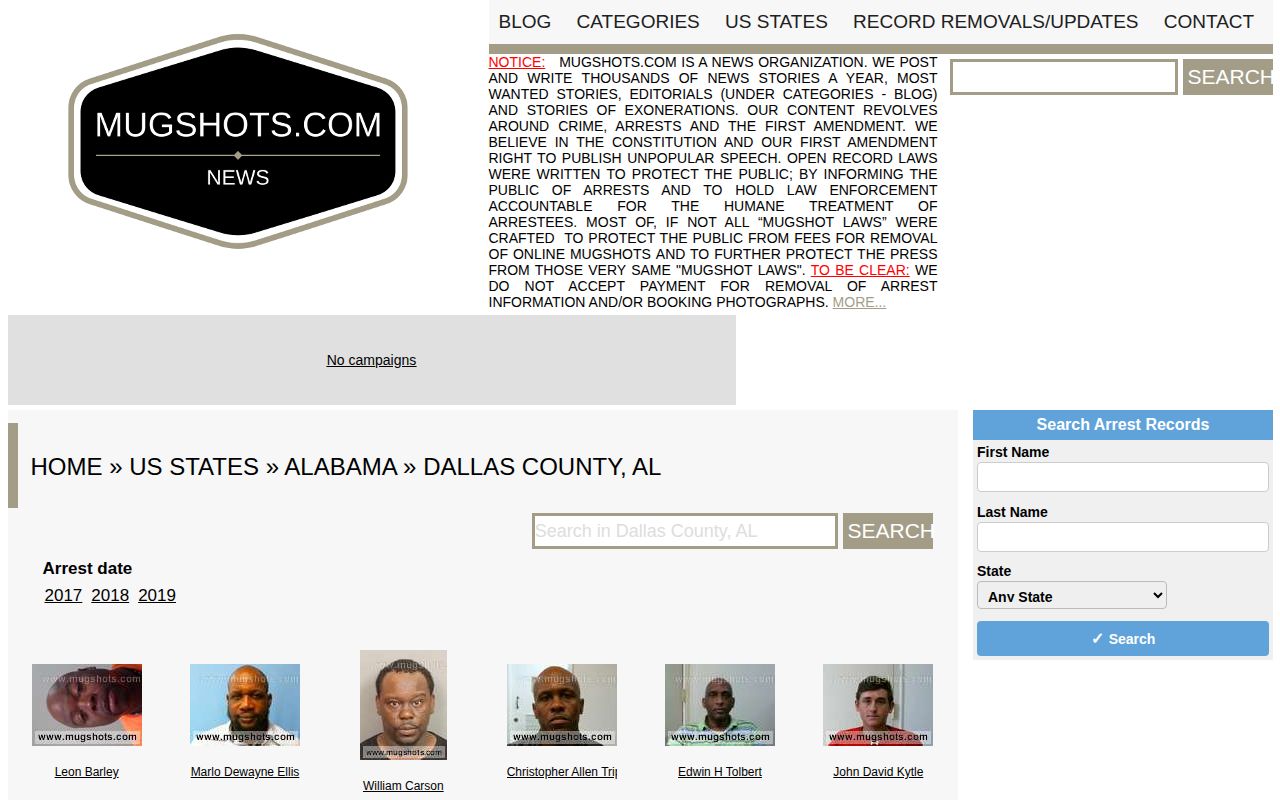
Verify any name or charge with the arresting office and the current court docket. Publication dates, booking dates, and case outcomes do not always line up.
Dallas County Busted Roster Fallback
The official jail page is a facility and contact page. It offers no inmate cards, name search, booking-photo results, paging controls, or archive. So no claim can be made about refresh times, post-release removal, photo policy, or visible search fields.
| Expected roster feature | Dallas County finding |
|---|---|
| Public portal URL | None verified |
| Search fields | None published |
| Booking photographs | None displayed |
| Update cadence | Not disclosed |
| Release persistence | Not disclosed |
| Online archive | None linked |
No Dallas County, Alabama sheriff app was verified. Results pointing to Dallas County, Texas, to Arkansas, or to Mobile County, Alabama are false matches. Until the Sheriff posts a verified tool, stick with the published jail and records contacts.
The fallback works in two steps. First, ask a narrow custody question: is the named person currently held, released, or transferred? Second, request a copy of the underlying record. Staff can often confirm a current status without treating the call as a formal records production. When identity is uncertain, supply the full name, the approximate arrest date, a date of birth if known, and the arresting agency. A common-name match is never safe to assume.
Note: Recheck the official county navigation before each lookup, since temporary-facility arrangements and vendors can change.
No Dallas County Booking App
The Dallas County, Alabama Sheriff has no official mobile app. App stores turn up lookalikes. Those lookalikes cause real confusion. A Dallas County, Texas tool or a Mobile County, Alabama app will not show Dallas County bookings. The safest rule is simple: trust an app only if the county or the Sheriff's own website points to it.
Social media can fill part of the gap. Posts from the Sheriff or police may announce arrests, investigations, and alerts. Still, they are handpicked items rather than a booking feed. An old post rarely says whether someone was later released. Until a verified app exists, call the jail for current custody, write the Sheriff for the booking packet, and check the court file for what followed the arrest.
Recent Dallas County Busted Bookings
Dallas County posts no daily or weekly booking list online. There is no 24-hour, 48-hour, 72-hour, or municipal roster either. That gap has consequences. Nobody can learn who got busted last night from an official roster, and there is no weekend update surge to track. Posts from the Sheriff or city police are announcements, not a full arrest log.
So ask directly. Start with the jail to confirm who is in custody right now. Then request the intake sheet and photograph from the Sheriff. Ask too whether the person was released or moved, since a released person can drop off a live custody check while the booking record itself still sits with the custodian.
Feed windows: no same-day or multiday Dallas County feed exists officially, so a records request remains the main documented route.
Dallas County Booking Custody Stages
Pick your locator by custody stage, not by search term. County intake, state prison, federal custody, immigration detention, and an open court case are five separate worlds. One system will not answer for another.
| Status | Best source | What it establishes |
|---|---|---|
| Just arrested or locally held | Arresting agency and Dallas County Jail | Current local custody and record creator |
| Released or transferred | Sheriff booking record and court docket | Past intake plus later case events |
| Sentenced to state prison | ADOC Inmate Search | Current state custody and possible institutional photo |
| Federal custody | BOP Inmate Locator | Federal location and release data, no public photo |
| ICE detention | ICE detainee locator | Covered immigration custody, no photo gallery |
| Case outcome | Dallas County clerk or Just One Look | Charges filed, events, and disposition |
ADOC searches work best with a six-digit AIS number. Name results are limited. Its institutional photo may not match the original Dallas County booking image. The BOP locator reaches federal inmates back to 1982, but it shows no photographs. ICE sets its own identity rules and leaves out anyone under 18.
Dallas County Arrest Dispositions
The Dallas County Circuit Clerk keeps circuit, district, criminal, juvenile, civil, and other case records. The office sits at 105 Lauderdale Street in Selma and closes to the public on Wednesdays. For online access, Just One Look is the paid case-by-case option. Before deciding two entries involve the same person, match the county, case number, arrest date, charge sequence, and identity details.
Each stage has its own meaning. Booking opens the custody paperwork. The initial appearance covers notice, counsel, and release conditions. A plea to the operative charge comes at arraignment. "Disposed" covers several possible endings and does not mean convicted. Selma misdemeanors usually run through municipal court, while county felonies and similar matters take the county court path.
- Booking
- Jail intake and identity processing after arrest.
- Bond
- A court-set condition for release while a case is pending.
- Arraignment
- The stage when a plea is entered.
- Disposition
- The recorded outcome of the case or charge.
- Expungement
- A court process that restricts eligible records under statute.
Dallas County Custody Alerts
The Alabama Victim Notification System sends alerts about convicted offenders held in ADOC custody. It is not a Dallas County pretrial roster, and it holds no mugshot archive. The current system went live in March 2024. Anyone registered under the old version had to sign up again. Users choose their notice preferences and keep contact details current.
VINELink may carry custody events where participating agencies feed it data. A blank result can mean a spelling issue, a transfer, a release, or no participation at all. For a fresh local booking, the Dallas County Sheriff is still the direct source.
Older Dallas County Booking Archives
Dallas County sets no fixed retention period for booking photos. There is no online historical jail archive either. Ask the Sheriff which Records Disposition Authority series covers each item, since the booking sheet, jail register, fingerprints, and photographs may sit on different schedules. A hold can also pause ordinary disposal. Litigation, an active investigation, or an expungement order all work that way.
An older trail does exist. Under Ala. Code § 36-22-13, completed sheriff books stay open for free inspection. They pass to a successor sheriff. Filled books eventually go to the circuit clerk. The Alabama incarceration collection holds historical state-prison material, sometimes with names, serial numbers, counties, offenses, dates, and register images. It is not a modern Dallas County mugshot gallery.
The source image below shows the Alabama Department of Archives and History incarceration search. Use it to separate old state-custody records from a recent county booking.
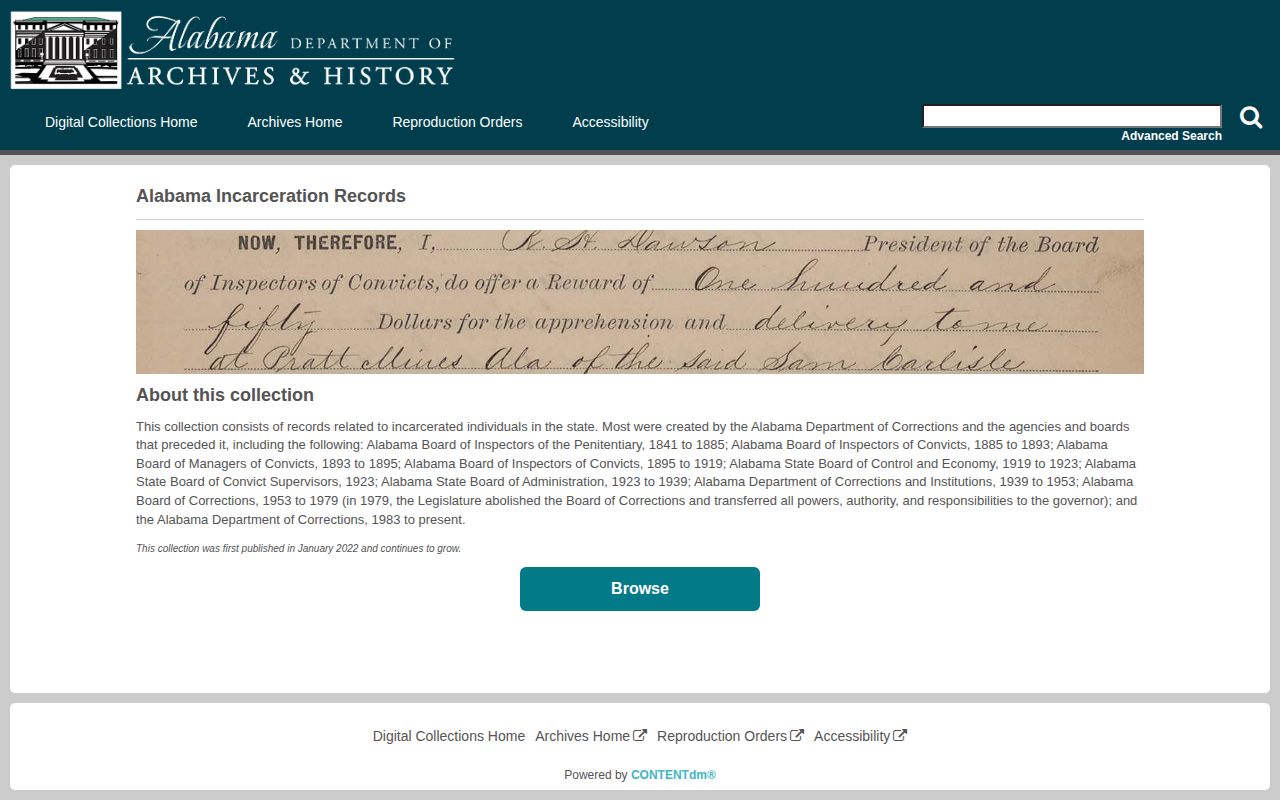
Work an older case in order: Sheriff first, then Circuit Clerk, then ADOC, then the state archives. Each source keeps a different slice of the story, and a docket may survive even when the photograph did not.
Busted Mugshots Across Dallas County
Three incorporated places make up Dallas County. Each runs its own record route, so city searches should always keep the arresting agency and the true jurisdiction attached.
- Selma Busted Mugshots: Selma Police handles city incidents, while the Sheriff holds county jail intake; municipal misdemeanors and county felonies can use different clerks.
- Valley Grande Busted Mugshots: the city publishes a contract-security relationship with the Sheriff and has no verified municipal blotter.
- Orrville Busted Mugshots: start with Alabama town and county sources because Ohio search results are a frequent false match.
None of the three municipalities posts a verified daily arrest log with booking photographs. Confirm which office made the arrest and where the person was held, because cases do not all follow the same path.